Showing posts with label Gothic Architecture. Show all posts

Definition Of Gothic Architecture: Its Origin, And Division Into Styles.

Monday, April 20, 2015 0 comments
This article (Definition Of Gothic Architecture: Its Origin, And Division Into Styles) is excerpted from the book entitled "The principles of Gothic ecclesiastical architecture. With an explanation of technical terms, and a centenary of ancient terms." Author: Bloxam, Matthew Holbeche, 1805-1888, Page 17-22.
Definition Of Gothic Architecture: Its Origin, And Division Into Styles.

The appellation of the word “Gothic,” when applied to Architecture, is used to denote in one general term, and distinguish from the Antique, those peculiar modes or styles in which our ecclesiastical and domestic edifices of the middle ages were built. In a more confined sense, it comprehends those styles only in which the pointed arch predominates, and it is then used to distinguish them from the more ancient Anglo-Saxon and Anglo-Norman styles.

The use of the term Gothic, in this country, first appears about the close of the seventeenth century, when it was employed by such writers as Evelyn and Wren, as an epithet intended to convey a feeling of disesteem for the structures of medieval architecture, which even the master mind of Wren was unable to appreciate. It has been since generally followed.

The origin of this kind of architecture may be traced to the classic orders in that state of degeneracy into which they had fallen in the age of Constantine and afterwards. The Romans, on their voluntary abandonment of Britain in the fifth century, left many of their temples and public edifices remaining, together with some Christian churches; and it was in rude imitation of these Roman buildings of the fourth century that the most ancient of our Anglo-Saxon churches were constructed. This is apparent from an examination and comparison of them with the vestiges of Roman buildings still existing.

No specific regulation has been adopted, with regard to the denomination or division of the several styles of English Ecclesiastical Architecture, in which all the writers on the subject agree : hut they may be divided into seven, which, with the periods when they flourished, are defined as follows:

The Anglo-Saxon style prevailed from the mission of St. Augustine at the close of the sixth to the middle of the eleventh century.

The Anglo-Norman style may be said to have prevailed generally from the middle of the eleventh to the latter part of the twelfth century.

The Semi-Norman, or Transition style, appears to have prevailed during the latter part of the twelfth century.

The Early English, or general style of the thirteenth century.

The Decorated English, or general style of the fourteenth century.

The Florid, or Perpendicular English, the style of the fifteenth, and early part of the sixteenth century.

The Debased English, or general style of the latter part of the sixteenth, and early part of the seventeenth century, towards the middle of which Gothic architecture, even in its debased state, appears to have been almost discarded.

The difference of these styles may be distinguished partly by the form of the arches, which are semi-circular or segmental, simple or complex pointed, though such forms are by no means an invariable criterion; by the pitch and construction of the roof, by the size and shape of the windows, and the manner in which they are subdivided or not, by mullions and tracery; hut more especially by certain details, ornamental accessories and mouldings, more or less peculiar to each.

The majority of our cathedral and country churches have been built, or added to, at different periods, therefore they seldom exhibit an uniformity of design ; and many have parts about them of almost every style. There are, however, numerous exceptions of churches erected in the same style through-out ; and this is more particularly observable in those of the fifteenth century.

The general ground plan of cathedral and conventual churches was after the form of a Cross, the edifice consisting of a central tower, with transepts running north and south; westward of the tower was the nave or main body of the structure, with AISLES. The WEST FRONT contained the principal entrance, and was frequently flanked by towers. Eastward of the central tower was the CHOIR also with aisles, where the principal service was performed, and beyond this was the LADY CHAPEL. The design also sometimes comprehended other chapels. On the north or south side, generally on the latter, was the CHAPTER HOUSE, in early times quadrangular, but afterwards octagonal in plan; on the same side, in most instances, were the CLOISTERS, which communicated immediately with the church, and surrounded a quadrangular court, bounded on the side parallel with the church by the refectory. The chapter house and cloisters we still And remaining as adjuncts to most cathedral churches, though the conventual buildings of a domestic nature, with which the cloisters formerly also communicated, have generally been destroyed. Mere parochial churches have commonly a tower at the west end, a nave, aisles, north and south porches, and a CHANCEL. Sometimes the tower is at the west end of one of the aisles, or at the side; occasionally we find it altogether detached from the church. Sometimes a turret occurs near the east end of the north or south aisle, containing a staircase which led to the Roodloft. Some churches have transepts; and to many have been annexed, at the cost of individuals, small side chapels or additional aisles, to serve for burial places and chantries. Over some few of these chantry chapels are chambers containing fireplaces, and so constructed with regard to their access, which can only be obtained through the church, as to form a “domus inclusa,” or residence for a priest. To some churches a “Vestiarium,” or vestry room, is attached; the usual position of this is on the north side of the chancel; sometimes we meet with it behind the altar, but we very seldom find it on the south side of the chancel, though there are instances of its being thus placed, and it has rarely an external entrance. The position of the porch is towards the west or the north or south side of the church; it has generally one bay or window intervening between it and the west wall. In some few instances it is placed close to the extreme west, but this is not appropriate. Many porches contain rooms over them. The smallest churches have a nave and chancel only, with a small bell-turret formed of wooden shingles, or an open arch of stonework on the gable at the west end. The eastern apex of the roof of the chancel was always surmounted by a stone cross.

Provincialisms often occur in the churches of particular districts; these appear to have sometimes originated from the building materials of the locality, sometimes from the small and scattered population. In the Isle of Wight, where timber appears to have been scarce, very little is used in the construction of the churches, and many of the porches are covered with stone slabs, supported by arched ribs without any framework of wood, the mouldings over doorways and windows are likewise unusually bold. In some parts of Essex, from the want of stone, the churches are poor in architectural display, and many of the belfries are of wood. In the north of Herefordshire, a thinly inhabited district, we meet with many small plain Norman or Early English churches, consisting only of a nave and chancel, with sometimes a low square Early English tower superadded, rising only to the ridge of the roof of the nave. In Wales they generally are exceedingly plain and poor, the material being of a stone not suitable for mouldings, and many of the church towers are very plain in construction and without buttresses, the masonry consisting of rag, some are furnished with an embattled parapet, and some are covered with a pyramidical roof. In the south of Northamptonshire we have a number of plain Decorated churches of a similarity of character, and there are likewise rich ones in the same style. In this county we may trace more gradually perhaps than in any other the changes in ecclesiastical architecture, step by step, from the seventh century down to the Reformation. Early English and Decorated spires abound in the northern parts of the county. In some parts of Lincolnshire, fine and costly decorated churches with spires prevail. In this county we also find many late examples of a transitional character of Anglo-Saxon work. Somersetshire is rich in churches of the fifteenth century, of the Perpendicular style, with lofty towers more or less covered by panel work, and the spires are few. In some districts the aisles of many of the churches are extended eastward as far as the east wall of the chancel. In other parts of the country provincialisms are also found.

The Influence of Persian and Romanesque in Gothic Architecture

Monday, August 20, 2012 0 comments
Almost at the same time asa suger’s re building of Saint-Denis, the cathedral of Sens, the first cathedral in Gothic style, was built. Its main nave is still of squat proportions, less upward-striving than many a late-Romanesque minster, and originally, before the windows of the clerestory had been erected and the spaces between the vaulting filled in, it seemed even more solid. Nevertheless, the rib vaulting, and the way in which its sinews run together like a bundle of shafts and continue to the ground, is thoroughly Gothic. The logical coherence of the Gothic style of construction is already there, seemingly at one stroke.
Whence came the idea, and also the technical knowledge, without which no one would have been able to build these audacious arches? Certain elements are already present in Romanesque architecture, but the decisive model derives from far away, namely from Islamic art, with which the Franks had for long (since the beginning of the Christian reconquest of Spain) been in touch, and which now from many sides, at the time of the crusades, exerted an influence on the European world of forms. It is important to remember that from the year i too Jerusalem was the capital of a Frankish kingdom, and that the Order of Templars, which was founded in 1118 under the spiritual protection of St. Bernard of Clairvaux, raised on both sides of the Mediterranean its own army of building workers.
In Moorish Spain, in Cordoba and Toledo, there were cupolas supported on intersecting stone ribs. Closer to the Gothic style, however, are certain cupolas that are found in North Africa and, in their purest form, in Persia. They are char­acterized not only by being loosely set on a framework of ribs, but by spanning therein several surfaces or facets. In this way the ribs are scarcely visible on the inside of the cupola, but appear on the outside — usually a timber-clad roof—as pectinate ridges, which support the vaulting by their curved span. This unusual building technique, which differs from that of Gothic, arose because the cupolas, with their ribs, were built over a basket-like framework made of twigs. This could not be done in stone; in the case of stone, the ribs had first to be constructed for themselves, and only when they were entirely firm could the shells be placed on or between them. The ribs were thus transmuted from purely spanning to bearing elements.
That one should find the model for Gothic vaulting in medieval Persia is not surprising: French culture of the twelfth and thirteenth centuries readily adopted forms from the Islamic world, with which it was in touch, and especially those forms that were of Persian origin. This elective affinity is to be seen not least in the knightly epics of both sides. The generally Islamic influence, however, is prevalent in almost all the knightly forms of the medieval West; minnesingers and trouba-dours were stimulated by Arabo-Persian models, and the Christian knightly orders themselves would have been inconceivable without their Islamic predeces­sors, which based themselves on the Koranic precept for the Holy War.
OLYMPUS DIGITAL CAMERA
vault great mosque isfahan

What Gothic architecture has in common with its Islamic prototype is its joy in the geometrical play of lines, as well as its endeavour to overcome any impres­sion of mass and weight. Both characteristics came increasingly to the fore as the Gothic style developed, right up to the geometrical web of late-Gothic vaulting. What is completely foreign to the Islamic prototype, however, is the way in which the Gothic style incorporates the roof, stretched between the ribs of the vault, into the rest of the building. The 'braided' cupola of Islamic buildings seems to hover; it is only imperceptibly supported by the walls. Gothic vaulting, on the other hand, delivers its arches and ribs directly onto the pilasters and, through them, right down to the ground. This way of doing things was already present in French Romanesque architecture, in the clear articulation of the pilasters, directly linked to the ribs and the wall arcades of the cross vaulting. The architectural logic was already there and, in the Gothic style, the pillars corresponded exactly to the ribs of the vault as they converged downwards into a single bundle. It was because of this downward continuation of the ribs into the pillars that the walls became anal­ogous to the shells between the ribs of the vaulting. Like these shells, the walls were little more than delicate partitions spanning the space between the pillars. The walls only assumed this character to the full when, thanks to the buttresses providing support from without, they finally became as it were translucent tapes­tries. Until that occurred, the interior of the cathedrals, throughout the whole of the early Gothic period, retained something of the weighty structure of Romanesque churches, even if the apparently elastic power of the arches, and the shafts rising to the vault in an unbroken stream and descending again to the ground as it were in a downpour, conferred on the whole building a hitherto unknown rhythm and tension, which, in place of the contemplative repose of Romanesque architecture, proclaimed a new upward flight of the will.


Modern Analogies between Gothic Architecture and Scholasticism 2

Sunday, July 29, 2012 0 comments
Worringer writes, with obvious overstatement, that the interior of the Gothic cathedral is "all mysticism" and "the exterior construction is all scholasticism". As his argument develops, it becomes clear that his analogy to Scholasticism entails activity on both the inside and the outside of the cathedral. For Worringer it is "a certain involved, contorted movement of thought as such", not the specific content of Aquinas' theology, that links Gothic architecture to Scholasticism:
It was not the result of thought, but the abstract process of the movement of thought, which bred in the Scholastic that intellectual ecstasy which stupefied and liberated him,—in the same way as the abstract process of movement in the line, which he made visible in ornament, or . . . the abstract movement in the energies of stone, which he made visible in architecture.
Worringer takes the least of Ruskin's Gothic moral elements Redundancy or Generosity and gives it top billing. In effect, he locates in the form of Scholastic argument something akin to the concept of grace it articulates: a supplementary and gratuitous energy.

For Worringer, Gothic form synthesizes the dialectic between naturalistic and non-naturalistic styles in Western art history discussed in his 1908 bestseller, Abstraction and Empathy. There he defines artistic abstraction as a withdrawal of subjective feeling from the perceived object, reflecting a straining beyond the physical world, in contrast to empathy, which entails a transfer of feeling from subject to object, resulting in more naturalistic forms. Abstraction and Empathy was championed by the German expressionist artists Ernst Ludwig Kirchner and Emil Nolde, as justifying their angular, energetic style, and was applied by the English critic T. E. Hulme to his prescient discussions of modernist abstraction in art and literature. Even as the Great War raged, damaging cathedrals at Soisson, Rouen, and Reims, Worringer oversaw a fourth edition of Form in Gothic while on leave from the front, where the Northern impulse for redundant movement was finding new expression in trench warfare. Ironically, his sharp distinction between Northern and Classical styles was co-opted by the Nazis, who denounced expressionism as degenerate and propagated representational art and classical architecture as tonics for the German nation.

Erwin Panofsky was art historian and rector at the University of Hamburg (the first Jewish rector of a German university), until the Nazis ousted him in 1933 and he began a distinguished academic career in the United States. In 1948 he delivered the Wimmer Lecture at Saint Vincent Archabbey in Latrobe, Pennsylvania, published in 1951 as Gothic Architecture and Scholasticism and later issued in paperback and numerous translations. Panofsky proposes manifestatio "CLARIFICATION FOR CLARIFICATION'S SAKE" as the formal principle uniting Gothic architecture and Scholastic theology (Gothic 34-35). Cutting through Worringer's vague racial model to a more sophisticated understanding of Scholasticism, and, like Adams, a greater focus on master architects as intellectuals (exposed to Scholastic ideas, he argues), Panofsky sobers Worringer's intoxication of the senses. Indeed, he finds in Gothic architecture the very clarification that for Worringer is the antithesis of the Gothic and the essence of Classicism. Panofsky argues that three core principles of Scholastic argument also apply to Gothic architecture. Firstly, "totality (sufficient enumeration)." Like Scholastic theology, the High Gothic cathedral "sought to embody the whole of Christian knowledge, theological, moral, natural, historical, with everything in its place and that which no longer found its place, suppressed" (Gothic 31, 44-45). Secondly, "arrangement according to a system of homologous parts and parts of parts (sufficient articulation)." Just as the well-ordered Scholastic treatise is arranged in a hierarchy of consistent logical levels, so the Gothic cathedral divides into nave, transept, and chevet, with a hierarchy of subdivisions, resembling one another in their pointed arches and triangular ground plans—a uniformity that sets the Gothic apart from the Romanesque (Gothic 31, 45-49). As Aquinas maintains, "the senses delight in things duly proportioned as in something akin to them; for the sense, too, is a kind of reason as is every cognitive power" (qtd. in Panofsky, Gothic 38). And finally, "distinctness and deductive cogency (sufficient interrelation)." The homologous order mirrored in different parts of the cathedral, as in the treatise, is balanced by the clear articulation between parts: between shafts and walls, between vertical elements and their arches. Simultaneously, the Gothic style requires a mutual inference among parts, so that we can "infer, not only the interior from the exterior or the shape of the side aisles from that of the central nave but also, say, the organization of the whole system from the cross section of one pier" (Gothic 31, 50-51).

For Panofsky, the Gothic cathedral, like the Scholastic summa, is an edifice of "solutions" to organizational problems faced by master intellectuals. Where Worringer sees a superabundance of random movement, inspired by unconscious racial character, Panofsky sees "gratuitous clarification" consciously achieved (Gothic 60). Panofsky's conception of the Gothic implicitly rejects Ruskin's notion of an "unaccusable whole" arising willy-nilly from "the labour of inferior minds." Gothic Architecture and Scholasticism typifies Panofsky's signature theory of iconology, whereby the visual image codifies "those underlying principles which reveal the basic attitude of a nation, a period, a class, a religious or philosophical persuasion—qualified by one personality and condensed into one work" (Panofsky, Meaning 30). This theory, focusing on the work of educated personalities, underlies Panofsky's study of linear perspective as the central "symbolic form" of the Renaissance, the key to politics, philosophy, and poetry, as it does his influential essay on motion pictures, which he compares, in their massive coordination of artists under a central vision, to medieval cathedrals.

For all their differences, Ruskin, Adams, Worringer, and Panofsky each tell a story of decline. The medieval synthesis came apart. The Renaissance, in Ruskin's view, suppressed individual workers' creativity and, according to the others, unleashed separate strains of mysticism and empiricism that Scholastic theology and Gothic architecture had, for a time, held together. These writers traced analogies between the Gothic and the Scholastic as a refuge, perhaps, from modern societies that offered no coherent belief to anchor artistic experimentation. At the same time, however, formal order—where form and function merge, and ornament, even if seemingly gratuitous, streams into a meaningful whole—is the underlying dream of modernism, as it was, for these writers, the aspiration of Gothic architecture. These studies are highly original works of imagination, mutually illuminating yet isolated from one another (the absence of Ruskin from Adams' book, and of Worringer from Panofsky's, are matters of choice). Although criticized as scholarship, each survives as a work of creativity. Panofsky's study is the most scholarly of the four, but the least emotionally satisfying, and the least nervous: the fretting of remote Gothic artisans, the mysterious ascent of towers, the gratuitous motion of tracery, all fire the imagination more than does gratuitous clarification. However, Ruskin, Adams, Worringer, and Panofsky all discerned in Gothic architecture and Scholasticism a particular synthesis of organic detail and abstract form, resonant with their intellectual, aesthetic, and social visions, and perhaps with their emotional needs. Medieval Gothic is an outcast, earlier modernism in which later modern observers, working amid shifting forms of society and culture, have repeatedly imagined themselves. "It is that strange disquietude of the Gothic spirit that is its greatness," Ruskin writes; "that restlessness of the dreaming mind, that wanders hither and thither among the niches, and flickers feverishly around the pinnacles, and frets and fades in labyrinthine knots and shadows along the wall and roof, and yet is not satisfied, nor shall be satisfied. . . . The work of the Gothic heart is fretwork still . . ." (165; italics original).
 
Murphy / Nervous Tracery

Modern Analogies between Gothic Architecture and Scholasticism 1

0 comments
The Gothic style presents an interesting case of how the Middle Ages have persisted in Western history through the backward glances, sometimes leery, sometimes wistful, of subsequent periods. First arising in the seventeenth century as a derogatory term for the anti-classical, "barbarous" style adopted by European cathedral builders beginning in the twelfth century, the word "Gothic" became attached in the eighteenth century to a type of sensational narrative set in infelicitous buildings. During the Gothic revivals of the nineteenth and early twentieth centuries, Gothic architecture shed its morbid associations and was admired both for its aesthetic form and for the integral relationship of that form to a theological vision. Symbolizing, as Arthur Symons wrote in 1899, "the very soul of the Middle Ages," the Gothic cathedral came to epitomize the medieval impulse toward synthesis in theology as well as the arts. Indeed, St. Thomas Aquinas' colossal reconstruction of Christian theology on Aristotelian principles in the Summa Theological—architectural in its form and ambition—mirrored the synthesis between faith and reason, transcendence and empiricism, at work in the Gothic style. Although the concept of synthesis was a commonplace of medieval thought— evident in Dante's Commedia as in summas and cathedrals—it became the mission of latter-day interpreters to detect oblique unities among these distinct medieval enterprises.

This essay will trace a path through four texts from the mid-nineteenth through the mid-twentieth centuries that define a relationship between medieval Gothic architecture and Scholastic theology: John Ruskin's essay "The Nature of Gothic" in The Stones of Venice (1851-53); Henry Adams' Mont Saint Michel and Chartres (1904); Wilhelm Worringer's Form in Gothic (Formprobleme der Gothic, 1911); and Erwin Panofsky's Gothic Architecture and Scholasticism (1951).1 In these widely read works, influential beyond the field of art history, the seemingly arcane analogy between the Gothic and the Scholastic becomes a proving ground for the projects of prominent intellectuals within distinct historical and cultural contexts. For each author, the meaning of the Gothic hangs in a particular balance between its tracery—that is, its naturalistic ornamental detail—and its architectural structure: the balance between the concrete and the abstract, between multiplicity and unity, that is also achieved in Scholastic theology. Because their analogies between the Gothic and the Scholastic isolate distinct lines of force within these complex systems, these writers each identify different values there, revealing as much about the modern mind as about the medieval. The syntheses that their medieval forbears accomplished collectively in service of faith, these interpreters seek independently in service of their own cultural identity, aesthetic values, or intellectual coherence.

John Ruskin's essay "The Nature of Gothic" is the most eloquent expression of the English Gothic revival, even as Barry and Pugin's Houses of Parliament (1840-60) are its most iconic. In order to clarify the transition between Venetian Byzantine and Gothic forms, Ruskin posits an idealized Gothic style that is recognizably Northern, unfettered by the Arab influences that colored its flowering in Venice beginning in the thirteenth century. He identifies six "characteristic or moral elements" in Gothic architecture, in order of importance: Savageness, Changefulness, Naturalism, Grotesqueness, Rigidity, and Redundancy, corre­sponding with six characteristics of Gothic builders: Savageness or Rudeness, Love of Change, Love of Nature, Disturbed Imagination, Obstinacy, and Generosity (141). For Ruskin the Gothic is not only an architectural style but a Northern cast of mind shared by his Anglo-Saxon audience, to whose "Gothic spirit" he appeals (139). This spirit takes the external form of "Foliated Architecture, which uses the pointed arch for the roof proper, and the gable for the roof-mask" (204; italics original). Ruskin associates the gable with the savageness of Northern weather it being the best roof for casting off snow and rain while the pointed arch is a function of Changefulness because, unlike the rounded arch, it is open to endless formal variation. Foliation, the architectural "adaptation of the forms of leafage" (200), is the feature that expresses the greatest breadth of Gothic spirit: Naturalism, of course, as well as the Savageness and Changefulness (variety) of the wilderness. Foliation also embodies Rigidity, which Ruskin defines as "the peculiar energy which gives tension to movement, and stiffness to resistance" (186). In "Gothic vaults and traceries," he writes, "there is a stiffness analogous to that of the bones of a limb, or fibers of a tree; an elastic tension and communication of force from part to part, and also a studious expression of this throughout every visible line of the building" (186). "Gothic ornament," he observes, "stands out in prickly independence,... here starting up into a monster, there germinating into a blossom; anon knitting itself into a branch, alternately thorny, bossy, and bristly, or writhed into every form of nervous entanglement" (186). Redundancy is, finally, also a characteristic of foliation, which accumulates until "the cathedral front [is] at last lost in the tapestry of its traceries, like a rock among the thickets and herbage of spring" (190).

Ruskin locates the religious meaning of Gothic architecture not in its vertical aspiration but in its foliated detail. In contrast to ancient Greek architecture, where standardized ornamentation evinces the subservience of worker to master designer, Gothic architecture expresses the imaginations of individual, rough-and-ready artisans. "It is, perhaps, the principal admirableness of the Gothic schools of architecture," he writes, "that they thus receive the results of the labor of inferior minds; and out of fragments full of imperfection, and betraying that imperfection in every touch, indulgently raise up a stately and unaccusable whole" (146). Here Ruskin identifies the Christian principle that every soul is at once imperfect and uniquely valuable, "tending, in the end, to God's greater glory" (146). Although Ruskin does not mention him explicitly, this analysis certainly rests on Aquinas' belief that the variety and imperfection of creation glorifies God. Aquinas writes in the Summa Contra Gentiles:
Since every created substance must fall short of the perfection of divine goodness, in order that the likeness of divine goodness might be more perfectly communicated to things, it was necessary for there to be a diversity of things, so that what could not be perfectly represented by one thing might be, in more perfect fashion, represented by a variety of things in different ways.
For Ruskin, the Gothic cathedral dramatizes this fundamental Scholastic operation, from which he moves to a condemnation of copying and exact finish in English manufacturing, to the aesthetic claim that "the demand for perfection is always a sign of a misunderstanding of the ends of art" (156; italics original). Thus Ruskin appeals to the Northern identity of his English readers ultimately to upbraid them for abandoning their ancestral aesthetic and social values.
Henry Adams, in his Mont Saint Michel and Chartres, expressed the sentiments of the American Gothic revival as passionately as Ruskin did the English. The grandson and great-grandson of Presidents John Quincy Adams and John Adams, and an authority on both American and medieval history, Henry Adams was uniquely situated to explain medieval culture to American readers. Writing after 1900 as an informed observer of breakthroughs in physics and engineering, Adams shifts attention away from Gothic fretwork and toward its mechanistic superstructure. For him, the cathedral is more the product of master architects than naive craftsmen. His book culminates in an extended analogy, point for point, between the vertical lines of the Gothic cathedral and Aquinas' account of the free will's ascent toward God. In Aquinas' Church Intellectual, the vaulting is the tour de force:
He swept away the horizontal lines altogether, leaving them barely as a part of the decoration. The whole weight of his arches fell as in the latest Gothic, where the eye sees nothing to break the sheer spring of the nervures [ribs of the groined vault], from the rosette on the keystone a hundred feet above, down to the church-floor. In Thomas's creation nothing intervened between God and his world; secondary causes become ornaments; only two forces, God and Man, stood in the church. (Adams, Mont Saint Michel 334)
The stability of this structure depended on Aquinas' success, through "architectural obstinacy," in establishing man as "an energy independent of God" (343, 345), first by asserting that "souls were not created before bodies" (337); and second, by teasing out a concept of free will within a universe generated in a single "instantaneous act, for all time" (336). Man's free will, Aquinas argues, is a reflex action of God's original free act of creation. And grace, defined by Aquinas as "a motion which the Prime Motor, as a supernatural cause, produces in the soul, perfecting free will" (qtd. in Adams, Mont Saint Michel 352), becomes in Adams' more mechanistic gloss, "a reserved energy, which comes to aid and reinforce the normal energy of the [human] battery" (352). Turning to the Gothic cathedral, he analogizes the reserved energy of grace to the apparently effortless rising of the fleches of Chartres and Laon:
The square foundation-tower, the expression of God's power in act,—his Creation,—rose to the level of the church fa?ade as a part of the normal unity of God's energy; and then, suddenly, without show of effort, without break, without logical violence, became a many-sided, voluntary, vanishing human soul.... (356)
Adams compares the Summa Theological to Beauvais, the tallest Gothic cathedral, as "excessively modern, scientific, and technical, marking the extreme points reached by Europe on the lines of scholastic science." The "despotic central idea" of both is "that of organic unity ... in the thought and the building" (356-57).
Mont Saint Michel and Chartres, Adams' paean to "Thirteenth-Century Unity," must be understood in the context of his subsequent autobiography, The Education of Henry Adams (1907), which he called "a Study of Twentieth-Century Multiplicity" (Education 435). For Adams, the doctrine of unity is what distinguishes the medieval period from the modern, when science and art abandoned unity for "complexity, multiplicity, variety, and even contradiction" (Mont Saint Michel 357). However, he finds continuity between the modern and medieval periods in their confrontations with overwhelming power. Describing a visit to the 1900 Paris Exposition in the Education, Adams famously pairs the electric dynamo, on the one hand, and the Virgin and the Cross, on the other, as symbols of infinity exerting comparable "attractions on thought" (383). The emotional tone of his Gothic cathedral is therefore colored by a modern anxiety about its fragility as well as an attraction to its familiar power. Adams expresses this ambivalence best when he describes the ribs of the groined vault, the nervures:
Of all the elaborate symbolism which has been suggested for the gothic Cathedral, the most vital and most perfect may be that the slender nervure, the springing motion of the broken arch, the leap downwards of the flying buttress,—the visible effort to throw off a visible strain, never let us forget that Faith alone supports it, and that, if Faith fails, Heaven is lost. (359)
Nervures and flying buttresses are the nervous byproducts of divine grace, conducting anxiety into the earth as the spire rises effortlessly toward the sky. The Gothic cathedral, Adams concludes, is "the cry of human suffering" (359).

In Form in Gothic, the German art historian Wilhelm Worringer compares the Gothic and the Scholastic by striking a middle course between Ruskin's focus on ornament and Adams' on structure. For Worringer, "[t]he Gothic cathedral is the most powerful and comprehensive presentation of mediaeval feeling" because it unites the "organically sensuous" and the "abstractly mechanical" (163). This unity is achieved subtly through the communication between the distinct energies of the cathedral's interior and exterior. Inside, sensuous ornamental details achieve a super-sensuous, abstract energy through their combined upward motion. Outside, these vertical forces attain freer and more legible expression: unconstrained by the competing horizontal push toward the altar on the interior (a throwback to the basilica form), and assisted by flying buttresses, the upward thrust shoots untrammeled into the towers. For Worringer, "the Gothic will to form" is characterized by "exalted hysteria" for "strongly expressive activity" which, moving upward, "dematerializ[es] the body of the building" and transcends its stone substance (79, 156-57; italics original). Gothic architecture induces "intoxication of the senses" through "pathos of space," in contrast to the "sensuous clarification" of classical buildings (159; italics original). Worringer identifies the Gothic will with "Northern," Germanic man, in contrast to "Classical" man, whose "felicitous state of spiritual equilibrium" produces balanced, rational forms (33). His terms, contrasting Northern and Classical, are thus remarkably similar to Ruskin's, but he reaches almost opposite conclusions. While Ruskin traces particular Gothic ornament back to rude Northern craftsfolk, each unique, Worringer perceives there the undifferentiated abstract motion characterizing Northern tribes in general. Ruskin highlights the naturalism, peculiarity, and independence of ornaments, but Worringer surveys them abstractly.
 
Murphy / Nervous Tracery

The Geometry Of Gothic Architecture

0 comments
A Brief Introduction To The Origins Of Gothic Architecture
The term Gothic was originally used as a derogatory moniker during the latter part of the Renaissance to describe what was then thought of as impure architecture. The Gothic style originated in France during the 12lh century and was known at the time as French Style. The Gothic architectural period lasted from the 12th century to the 16th century; Romanesque architecture preceding it and Renaissance architecture succeeding it.
The development of Gothic architecture in England during this period was categorized into three distinct styles by Thomas Rickman; Early English, Decorated, and Perpendicular.
During the early 19th century the style resurfaced into what became known as the Gothic Revival. Of the many architects of this period, perhaps the best known was A. W. N. Pugin for his work on the Palace of Westminster.
The Basics Of Geometrical Construction Techniques
To be able to construct successfully the shapes, proportions and lines of Gothic architecture, an understanding of the basics of geometry is needed; perhaps the most important of which is the understanding of bisection in the construction of angles.
Perpendicular Bisection Of A Straight Line
The perpendicular bisection of a straight line results in the creation of a 90° angle. From the drawin a-b represents the line to bisected. A circle, c, is constructed with it's centre on the line a-b - the radius of the circle isn't important as it serves purely as part of the construction. It should be noted however that the centre of circle c represents the point of bisection. At the two points where circle cuts through line a-b, construct two further circles, d and e equal in diameter but larger than the diameter of c. At the point of intersection of d and e construct the perpendicular x-y as shown. The line x-y is now at 90° to a-b and bisects it at the centre of circle c.
The Equilateral Arch
The most recognizable feature of Gothic architecture is the pointed arch. The basic gothic arch is equilateral in construction and forms the basis of many variants.
The construction of the equilateral arch is thus:
The construction of the equilateral arch
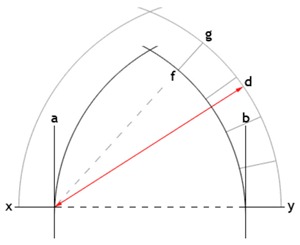
From the drawing, the compass is set to the span, a-b. With x-y as the springing line, the compass is positioned at the junction of a-x/y and a curve from xly-q is draw as shown. The procedure is repeated with the compass placed at the junction of b-x/y, with the point at which the curves join forming the rise p-q. Drawing straight lines from a-x/y to q and b-x/y to q it can be shown that the resulting triangle is equilateral in construction with all angles being 60°.
Setting Out The Extrados & Joints
basic arch constructed
With the basic arch constructed and forming the intrados, the drawing can be further developed to set out the extrados and joints of the arch stones.
With the compass again positioned at the junction of a-x/y, extrados d is formed at the desired distance from the intrados set out in the previous drawing.
Keeping the compasses at this length, the opposite side of the extrados is drawn from the point b-x/y. By scribing a straight line from the points a-x/y to the extrados d, the voussoir joints can be set out as shown at f-g.  Using the point b-x/y, the voussoir joints on the opposite side of the arch can be set out in the same manner.
 
Sam Fridlington

LATE GOTHIC PERIOD

Thursday, July 12, 2012 0 comments
Late gothic period Paris had been the leading artistic center of northern Europe since the 1230s. After the ravages of the Plague and the outbreak of the Hundred Years' War in the 1350s, however, Paris became only one among many artistic centers.
 
Painting As a result of this diffusion of artistic currents, a new pictorial synthesis emerged, known as the International Gothic style, in which, as foreshadowed by Pucelle, Gothic elements were combined with the illusionistic art of the Italian painters. Beginning in Paris in the 1370s and continuing until about 1400 at the court of Jean de France, Due de Berry, the manuscript illuminators of the International Gothic style progressively developed the spatial dimensions of their illustrations, until the picture became a veritable window opening on an actual world. This process led eventually to the realistic painting of Jan van Eyck and the northern Renaissance and away from the conceptual point of view of the Middle Ages. Thus, even though the International style is sometimes described as Gothic, it nevertheless lies beyond the boundaries of the Gothic period itself, which by definition is also medieval.

Sculpture
Gothic sculpture, however, remained unaffected by the Italian proto-Renaissance. About 1400 Claus Sluter executed at Dijon for Philip the Bold, Duke of Bourgogne, some of the most memorable sculptural works of the late Gothic period. Eschewing the slender willowy figure style and aristocratic affectations of the 14th century, Sluter enveloped his figures in vast voluminous robes. In the mourners on the tomb (begun 1385, Musee des Beaux-Arts, Dijon) of Philip the Bold, Sluter created out of drapery alone eloquent images of sorrow. In the statues surrounding the Well of Moses (1395-1403, Chartreuse de Champmol, Dijon) he transformed the Old Testament heroes into earthy Flemish patriarchs, whose realistic depiction nevertheless conveys a feeling of spiritual grandeur.

After Slutcr's death in 1406, his influence spread from Bourgogne to the south of France, to Spain, and later to Germany. By 1500, however, with Michel Colombe and the Mannerists of the school of Troyes in France and with Tilman Riemenschneider, Veit Stoss, and Adam Kraft in Germany, the era of Gothic sculpture drew to its close.

Architecture  In France, late Gothic architecture is known as flamboyant, from the flamelike forms of its intricate curvilinear tracery. The ebullient ornamentation of the flamboyant style was largely reserved for the exteriors of the churches. The interiors underwent a drastic simplification by eliminating the capitals of all the piers and reducing them to plain masonry supports. All architectural ornamentation was concentrated in the vaults, the ribs of which formed an intricate network of even more complicated patterns.

Flamboyant Style  Flamboyant architecture originated in the 1380s with French court architect Guy de Dammartin. The great surge in building activity, however, came only with the conclusion of the Hundred Years’ War in 1453, when throughout France churches were being rebuilt in the new style. The last flowering of flamboyant architecture occurred between the end of the 15th century and the 1530s in the work of Martin Chambiges and his son Pierre, who were responsible for a series of grand cathedral facades, including the west front of Troyes Cathedral and the transept facades of Senlis and Beauvais cathedrals. Disseminated over much of the Continent, flamboyant architecture produced its most extravagant intricacies in Spain. In Portugal, during the reign of King Manuel I, from 1495 to 1521, it developed into a national idiom known as the Manueline style, marked by a profusion of exotic motifs.

Perpendicular Style 
Spurning the flamboyant style altogether, the English builders devised their own late Gothic architecture, the Perpendicular style. The use of a standard module consisting of an upright traceried rectangle, which could be used for wall paneling and window tracery alike, resulted in an extraordinary unity of design in church interiors. The masterpiece of the style, the chapel of King’s College (begun 1443), Cambridge, achieves a majestic homogeneity through the use of the new fan vaulting, the fan-shaped spreading panels of which are in complete accord with the rectangular panels of the walls and windows.

Secular Buildings
The list of important secular monuments in the late Gothic period is long. In Belgium the series of grand civic halls, some with tall belfried towers, begins very early with the great Cloth Hall (completed 1380, destroyed 1915) of leper and continues with such later town halls as those of Leuven (1448-1463) and Oudenaarde (1526-1530). In England and France the austere castles of the 12th and 13th centuries had been little affected by the ecclesiastical architecture. In the last quarter of the 14th century, however, the grim fortresses were gradually replaced by graceful chateaux and impressive palaces that sometimes were the source of important architectural innovations. The earliest monument in the flamboyant style, the large screen (1388) with traceried gables that surmounts the triple fireplace in the ancient Palais des Comtes at Poitiers, foreshadowed the pieced decorative gables on the exteriors of the flamboyant-style churches. In about 1390 the largest of all medieval halls, that of London's Westminster Palace, was provided with a magnificent oaken hammer beam roof that furnished the prototype for numerous similar roofs in the parish churches of English towns.

In France from the late 15th century to the 1520s, new chateaux in the flamboyant style were being built extensively, from Amboise (1483-1501) and Blois (1498-1515) on the Loire, to Josselin (early 16th century) in Bretagne. The crowning features of their exteriors are those magnified versions of dormer windows, the lucarnes. Sometimes, as on the facade added in 1508 to the Palais de Justice at Rouen, the ornate lucarnes are each flanked by their own diminutive flying buttresses. Other regional styles of secular architecture also flourished, from the Venetian Gothic of the Doges' Palace (begun 1345?) and the Ca d'Oro (1430?) to the Tudor Gothic of Hampton Court (1515-1536) on the Thames and the Collegiate Gothic, which at Oxford lingered into the early 17th century. By this time on the Continent, however, the luxuriant growth of late Gothic forms had long since been replaced by the more intellectual and calculated architectural principles of the Renaissance.

DECORATIVE ARTS

0 comments
Decorative arts In France throughout the 13th century the decorative arts were largely dominated by church art. The medallions that form the illustrations in the Bibles moralisees (Moralized Bibles) of the second quarter of the century frankly emulate the designs of stained glass. In Louis IX's Psalter (composed after 1255), the gables with rose windows that frame the miniatures were patterned after the ornamental gables surmounting the exterior of the Sainte-Chapelle. Beginning about 1250 the same courtly style informs both monumental statues and small ivory figurines. The elegant ivory statuette of the Virgin Mary and Child (1265?, Louvre, Paris) from the Sainte-Chapelle was modeled after the monumental statue from the chapel's lower portal. The colossal group of Christ crowning the Virgin Mary in the central gable of the west facade of Reims possesses all the intimate grace of the same subject depicted in two contemporary statuettes, also in the Louvre. Beginning in the 1260s the large metal reliquary shrines take the form of diminutive Rayonnant churches, complete with transepts, rose windows, and gabled facades.
 
About 1300 the decorative arts begin to assume a more independent role. In the Rhineland, German expressionism gave rise to works of a marked emotional character, ranging from the statuettes of the school of Bodensee, such as that of the youthful seated Saint John tenderly laying his head on the shoulder of Christ, to the harrowing evocation of the suffering Christ in the plague crosses of the Middle Rhine. Later in the century the German sculptors were responsible for a new type of the mourning Virgin Mary, seated and holding on her lap the dead body of Christ, the so-called Pieta. In the second quarter of the century, Parisian manuscript illumination was given a new direction by Jean Pucelle. In his Belleville Breviary (1325?, Bibliotheque Nationale, Paris), the lettering, the illustrations, and the leafy borders all contribute to the totally integrated effect of the decorated page, thereby establishing an enduring precedent for later illuminators. Of still greater significance for future developments is the new sense of space imparted to the interior scenes in his illustrations through the use of linear perspective. Pucelle had learned this technique from the contemporary painters of the Italian proto-Renaissance {see Illuminated Manuscripts).

Diffusion of Gothic Sculpture

0 comments
Although northern France was the creative heartland of Gothic sculpture, as it was of Gothic architecture, some of the outstanding sculptural monuments were produced in Germany. Expanding on the French Gothic style, German Gothic sculpture ranges from an expressionistic exaggeration, sometimes verging on caricature, to a lyrical beauty and nobility of the forms. The largest assemblage of German 13th-century sculpture, that of the Cathedral of Bamberg, created under the influence of Reims, culminated about 1240 in the Bamberg Rider, the first equestrian statue in Western art since the 6th century. Although the identity of the regal horseman remains unknown, no other work so impressively embodies the heroic ideal of medieval kingship.
 
The influence of French Gothic sculpture in Italy was, like the architecture, more superficial and transitory than in Germany. This influence can indeed be aptly described as Gothicizing trends in the larger framework of the Italian proto-Renaissance that in sculpture began in 1260 with Nicola Pisano's marble pulpit in the Pisa Baptistry. Giovanni Pisano, the son of Nicola, was the first to adopt the full repertory of French Gothic mannerisms. Of great inner intensity and power, the statues of prophets and Greek philosophers he created about 1290 for the facade of the Cathedral of Siena are also the masterpieces of this entire Italian period.

Although during the later decades of the 14th century an ever-increasing number of Italian sculptors assumed the French Gothic mannerisms, again and again their works show the study of the classical nude and differentiate between body and drapery in a way that is the mark of the classical style. This Gothicizing phase had ended about 1400 with the advent of Lorenzo Ghiberti in Florence and the beginnings in sculpture of the full Italian Renaissance.

A Emergence of Naturalism Beginning

0 comments
A Emergence of Naturalism Beginning about 1210 on the Coronation Portal of Notre Dame and continuing after 1225 on the west portals of Amiens Cathedral, the rippling surface treatment of the classicizing drapery was replaced by more solid volumes. In the 1240s, on the west facade of Reims and in the statues of the apostles in the Sainte-Chapcllc, the drapery assumes those sharp, angular forms and deeply carved tubular folds that are characteristic of almost all later Gothic sculpture. At the same time the statues are finally liberated from their architectural bondage.
 
In the statues at Reims and in the interior of the Saintc-Chapelle, the exaggerated smile, almond-shaped eyes, and clustered curls of the small heads and the mannered poses result in a paradoxical synthesis of naturalistic forms, courtly affectations, and a delicate spirituality. Along with these manneristic tendencies and the increased naturalism, a more maternal type of the cult statue of the Virgin Mary playfully balancing the Christ Child on the outward thrust of her hip made its first appearance on the lower portal of the Sainte-Chapelle—an image that in the ensuing centuries was disseminated in infinite variations throughout Europe.

SCULPTURE

0 comments
Following a Romanesque precedent, a multitude of carved figures proclaiming the dogmas and beliefs of the church adorn the vast cavernous portals of French Gothic cathedrals. Gothic sculpture in the 12th and early 13th centuries was predominantly architectural in character. The largest and most important of the figures arc the over-life-size statues in the embrasures on cither side of the doorways. Because they are attached to the colonnettes by which they are supported, they are known as statue-columns. Eventually the statue-column was to lead to the freestanding monumental statue, a form of art unknown in western Europe since Roman times.
 
The earliest surviving statue-columns are those of the west portals of Chartres that stem from the older pre-Gothic cathedral and that date from about 1155. The tall, cylindrical figures repeat the form of the colonnettes to which they are bound. They are rendered in a severe, linear Romanesque style that nevertheless lends to the figures an impressive air of aspiring spirituality. During the next few decades the west portals of Chartres inspired a number of other French portals with statue-columns. They were also influential in the creation of that sculptural ensemble on the Cathedral of Santiago de Compostela, fittingly known as the Portico de la Gloria (completed 1188), one of the outstanding artistic achievements of medieval Spain.

All these proto-Gothic monuments, however, still retain a distinct Romanesque character. In the 1180s the Romanesque stylization gives way to a period of transition in which the statue begins to assume a feeling of grace, sinuosity, and freedom of movement. This so-called classicizing style culminates in the first decade of the 13th century in the great series of sculptures on the north and south transept portals of Chartres.

The term classicizing, however, must be qualified, for a fundamental difference exists between the Gothic figure of any period and the truly classical figure] style. In the classical figure, whether statue or relief, a completely articulated body can be sensed beneath, and separate from, the drapery. In the Gothic figure no such differentiation exists. What can be discerned of the body is inseparable from the folds of the garment by which it is enveloped. Even where the nude is portrayed, as in the statues of Adam and Eve (before 1237) on the German Cathedral of Bamberg, the body is largely reduced to an abstraction.

Dissemination of Gothic Architecture

0 comments
The influence of French Gothic architecture on much of the rest of Europe was profound. In France the scheme of Bourges, with its giant arcade and short clerestory, met with little response, but in Spain it was taken up again and again, beginning in 1221 with the Cathedral of Toledo and continuing into the early 14th century with the cathedrals of Palma de Mallorca, Barcelona, and Gerona. In Germany the impact of all phases of French Gothic architecture was decisive, from the early Gothic four-story elevation of the Cathedral of Limburg-an-der-Lahn (1225?) to the choir of Cologne Cathedral (begun 1248). Modeled on the Rayonnant choir of Amiens, the interior of Cologne exceeds in height even that of Beauvais. 

Italy and England, however, are the exceptions to this pervasive French influence. The peculiarly Italianate idiom of the Gothic churches of Florence and the superficial reminiscences of the French Gothic facades on the cathedrals of Siena and Orvicto are but transitory phases in a development that leads from the Italian Romanesque to Filippo Brunelleschi and the beginnings of the Renaissance. 

In England, French Gothic architecture intruded itself only twice, once in the 1170s in the eastern extension of Canterbury Cathedral and again in Henry Ill's Westminster Abbey (begun 1245), patterned on the general scheme of Reims, with Parisian Rayonnant modifications. Otherwise the English architects developed their own highly successful Gothic idiom. Rejecting the aspiring verticality and the functional logic of the French cathedrals, the English churches emphasize length and horizontally, replacing the French polygonal apse with a square east end that is sometimes further prolonged by a rectangular Lady chapel (a chapel devoted to the Virgin Mary, characteristic of English cathedrals). This extreme elongation often includes two separate transepts. The multiplication in the number of ribs, some of which are of a purely ornamental nature, is also characteristically English. 

The first major phase of this insular architecture, the early English period, is well represented (except for the 15th-century tower and spire) by the Cathedral of Salisbury (begun 1220). The introduction of bar tracery in Westminster Abbey led to an astonishing variety in tracery design. This Decorated period, with its lavish ornamentation, also produced such poetic creations as the lovely Angel Choir (begun 1256) of Lincoln Cathedral, and was responsible as well for that unique masterpiece of medieval architecture, the astounding octagon (begun 1322) of Ely Cathedral, with its wooden lantern and tower soaring over the crossing.

Rayonnant Gothic Period

0 comments
Beauvais was begun in 1225, the year before Louis IX, king of France, ascended the throne. During his long reign, from 1226 to 1270, Gothic architecture entered a new phase, known as the Rayonnant. The word Rayonnant is derived from the radiating spokes, like those of a wheel, of the enormous rose windows that are one of the features of the style. Height was no longer the prime objective. Rather, the architects further reduced the masonry frame of the churches, expanded the window areas, and replaced the external wall of the triforium with traceried glass. Instead of the massive effects of the High Gothic cathedrals, both the interior and the exterior of the typical Rayonnant church now more nearly assumed the character of a diaphanous shell.
 
All these features of the Rayonnant were incorporated in the first major undertaking in the new style, the rebuilding (begun 1232) of the royal abbey church of Saint-Denis. Of the earlier structure only the ambulatory and the west facade were preserved. The spirit of the Rayonnant, however, is perhaps best represented by the Sainte-Chapelle, the spacious palace chapel built by Louis IX on the lie de la Cite in the center of Paris. Construction began in the early 1240s, and the chapel was consecrated in 1248. Immense windows, rising from near the pavement to the arches of the vaults, occupy the entire area between the vaulting shafts, thus transforming the whole chapel into a sturdy stone armature for the radiant stained-glass windows.

In the evolution of Gothic architecture, the progressive enlargement of the windows was not intended to shed more light into the interiors, but rather to provide an ever-increasing area for the stained glass. As can still be appreciated in the Saintc-Chapellc and in the cathedrals of Chartres and Bourges, Gothic interiors with their full complement of stained glass were as dark as those of Romanesque churches. It was, however, a luminous darkness, vibrant with the radiance of the windows. The dominant colors were a dark saturated blue and a brilliant ruby red. Small stained-glass medallions illustrating episodes from the Bible and from the lives of the saints were reserved for the windows of the chapels and the side aisles. Their closeness to the observer made their details easily distinguishable. Each of the lofty windows of the clerestory, on the other hand, was occupied by single monumental figures. Because of their often colossal size, they were also readily visible from below. Beginning in the 1270s the mystic darkness was gradually dispelled as grisaille glass—white glass decorated with designs in gray—was more often employed in conjunction with colored panels, while the colors themselves grew progressively lighter in tone.

High Gothic Architecture Period

0 comments
The complexities and experiments of this early Gothic period were finally resolved in the new cathedral of Chartres (begun 1194). By omitting the second-story gallery derived from Romanesque churches but retaining the triforium, a simplified three-story elevation was reestablished. Additional height was now gained by means of a lofty clerestory that was almost as high as the ground-story arcade. The clerestory itself was now lighted in each bay or division by two very tall lancet windows surmounted by a rose window. At one stroke the architect of Chartres established the major divisions of the interior that were to become standard in all later Gothic churches.
 
The High Gothic period, inaugurated at Chartres, culminates in the Cathedral of Reims (begun 1210). Rather cold and overpowering in its perfectly balanced proportions, Reims represents the classical moment of serenity and repose in the evolution of the Gothic cathedrals. Bar tracery, that characteristic feature of later Gothic architecture, was an invention of the first architect of Reims. In the earlier plate tracery, as in the clerestory at Chartres, a solid masonry wall is pierced by a series of openings. In bar tracery, however, a single window is subdivided into two or more lancets by means of long thin monoliths, known as mullions. The head of the window is filled with a tracery design that has the effect of a cutout.

Reims follows the general scheme of Chartres. But another equally successful High Gothic solution to the problems of interior design occurs in the great five-aisled cathedral at Bourges (begun 1195). Instead of an enlarged clerestory, as at Chartres, the architect of Bourges created an immensely tall ground-story arcade and reduced the height of the clerestory to that of the triforium. The brief interval of the High Gothic period is followed in the 1220s by the nave of Amiens Cathedral. The soaring effects, muted at Chartres and Reims, were taken up again at Amiens in the emphasis on vertically and in the attenuation of the supports. Amiens thus provided a transition to the loftiest of the French Gothic cathedrals, that of Beauvais. By superimposing on a giant ground-story arcade (derived from Bourges) an almost equally tall clerestory, the architect of Beauvais reached the unprecedented interior height of 48 m (157 ft).

A Early Gothic Architecture Period

0 comments
In France, during the first half of the 12th century, Gothic rib vaulting appeared sporadically in a number of churches. The particular phase of Gothic architecture that was to lead to the creation of the northern cathedrals, however, was initiated in the early 1140s in the construction of the chevet of the royal abbey church of Saint-Denis, the burial church of the French kings and queens near the outskirts of Paris. In the ambulatory of Saint-Denis, the slim columns supporting the vaults and the elimination of the dividing walls separating the radiating chapels result in a new sense of flowing space presaging the expanded spaciousness of the later interiors.

Saint-Denis led in the 1160s to the first of the great cathedrals, Notre Dame (begun 1163) in Paris, and to a period of experimentation in voiding the walls and in reducing the size of the internal supports. The addition of an extra story to the traditional three-story elevation of the interior increased the height dramatically. This additional story, known as the triforium, consists of a narrow passageway inserted in the wall beneath the windows of the clerestory (upper part of the nave of a church, containing windows) and above the large gallery over the side aisles. The triforium opens out into the interior through its own miniature arcade.

GOTHIC ARCHITECTURE

0 comments
Architecture was the dominant expression of the Gothic Age. Emerging in the first half of the 12th century from Romanesque antecedents, Gothic architecture continued well into the 16th century in northern Europe, long after the other arts had embraced the Renaissance. Although a vast number of secular monuments were built in the Gothic style, it was in the service of the church, the most prolific builder of the Middle Ages, that the new architecture evolved and attained its fullest realization.
 
The aesthetic qualities of Gothic architecture depend on a structural development: the ribbed vault. Medieval churches had solid stone vaults (the structure that supports the ceiling or roof). These were extremely heavy structures and tended to push the walls outward, which could lead to the collapse of the building. In turn, walls had to be heavy and thick enough to bear the weight of the stone vaults. Early in the 12th century, masons developed the ribbed vault, which consists of thin arches of stone, running diagonally, transversely, and longitudinally. The new vault, which was thinner, lighter, and more versatile, allowed a number of architectural developments to take place.

Although the earliest Gothic churches assumed a wide variety of forms, the creation of a series of large cathedrals in northern France, beginning in the second half of the 12th century, took full advantage of the new Gothic vault. The architects of the cathedrals found that, since the outward thrusts of the vaults were concentrated in the small areas at the springing of the ribs and were also deflected downward by the pointed arches, the pressure could be counteracted readily by narrow buttresses and by external arches, called flying buttresses. Consequently, the thick walls of Romanesque architecture could be largely replaced by thinner walls with glass windows, and the interiors could reach unprecedented heights. A revolution in building techniques thus occurred.

With the Gothic vault, a ground plan could take on a variety of shapes. The general plan of the cathedrals, however, consisting of a long three-aisled nave intercepted by a transept and followed by a shorter choir and sanctuary, differs little from that of Romanesque churches. The cathedrals also retained and expanded the loveliest creation of French Romanesque architecture, the chevet—the complex of forms at the east end of the church that includes the semicircular aisle known as the ambulatory, the chapels that radiate from it, and the lofty polygonal apse encircling the end of the sanctuary. The major divisions of the interior elevation of the Gothic nave and choir are likewise derived from Romanesque precedents. On the other hand, the tall attenuated piers of the ground-story arcade, the pencil-thin vaulting shafts rising through the clerestory to the springing of the ribs, and the use of the pointed arch throughout the whole edifice all contribute to those unique soaring effects that constitute Gothic architecture's most dynamic expression.

With the exception of the western facade, the exterior of the Gothic cathedral, with its towering buttresses and batteries of winglike fliers, is essentially an exoskeleton designed for the support of the vaults. The west front, on the other hand, was independently composed. The large parallelogram of the Gothic harmonic facade, surmounted by twin towers, reiterates in its triple portals and in its threefold vertical divisions the three aisles of the interior, and the large rose window above the central portal provides a magnified focus for the whole design.

Gothic Art and Architecture

0 comments
Gothic Art and Architecture, religious and secular buildings, sculpture, stained glass, and illuminated manuscripts and other decorative arts produced in Europe during the latter part of the Middle Ages (5th century to 15th century). Gothic art began to be produced in France about 1140, spreading to the rest of Europe during the following century. The Gothic Age ended with the advent of the Renaissance in Italy about the beginning of the 15th century, although Gothic art and architecture continued in the rest of Europe through most of the 15th century, and in some regions of northern Europe into the 16th century. Originally the word Gothic was used by Italian Renaissance writers as a derogatory term for all art and architecture of the Middle Ages, which they regarded as comparable to the works of barbarian Goths. Since then the term Gothic has been restricted to the last major medieval period. The Gothic Age is now considered one of Europe’s outstanding artistic eras.

Gothic Architecture Labels